

Consciousness Seeking Form
The Lemurians and Project Hail Mary


I reached the final moments of Project Hail Mary in my earbuds and, almost in the same breath, returned to The Lemurians: A New Testament for the Soul. I’m not finished yet—but the ending is clearly in sight.
The timing wasn’t planned. Still, it felt quietly meaningful.
These are very different books, built through very different methods. They arise from separate imaginations, separate vocabularies, separate aims. And yet, encountering Andy Weir’s novel at this particular moment in my own work brought a subtle alignment into view—something present in both narratives, though never named by either.
Not stated outright. Not argued.
Simply implied.
Does consciousness seek matter?
Two Endings, One Convergence
Andy Weir is known for science fiction grounded in precision—stories where physics, engineering, and human ingenuity are tested under impossible conditions. In Project Hail Mary, that rigor reaches its peak.
Weir’s third novel is a triumph of modern science fiction—exact, relentless, driven by survival and the laws of the universe. The Lemurians: A New Testament for the Soul, by contrast, unfolds as something closer to a remembering: a metaphysical narrative concerned with memory, reincarnation, and the long arc of awareness moving through worlds.
And yet, as I finished Weir’s final chapters while setting down my own lines, the overlap became unmistakable.
Weir introduces Rocky—an intelligent being whose form could not be more alien to us: rocky, spider-like, evolved to exist under crushing gravity and density, communicating through vibration rather than speech. And still, Rocky is undeniably conscious. He reasons. He chooses. He sacrifices. He loves his people.
The novel quietly insists on something profound:
Consciousness is not married to the human form.
It will take whatever shape can hold it.
Matter as a Temporary Home
The Lemurians approach this same idea from another direction.
Rather than asking how consciousness arises from matter, it asks whether matter is something consciousness moves through—again and again—across epochs, civilizations, and planets. In this telling, Earth is not the center of awareness but one of its densest classrooms. Humanity is not the beginning of intelligence, nor its endpoint, but a chapter in a far older story of descent, forgetting, and gradual remembrance.
Reading Project Hail Mary at the moment I was writing, The Lemurians made something click:
Weir shows consciousness adapting outward—evolving into radically unfamiliar forms when conditions demand it.
The Lemurians suggest consciousness migrating inward—entering bodies that forget their origins so that experience can be earned rather than remembered.
One story looks forward into deep space.
The other looks backward into deep time.
Both reject the idea that awareness belongs to a single species or a single world.
Before Language, Before Form
There was another resonance I didn’t expect.
Rocky does not communicate with words. Meaning travels through frequency—through rhythm, vibration, harmonic pattern. Intelligence precedes language. Understanding arrives before symbols.
In The Lemurians, knowing does not arrive through words. It moves through presence.
The story gestures back to a time before language hardened thought into symbols—before feeling, meaning, and perception split into separate acts. In that earlier state, understanding wasn’t spoken or translated.
It was simply shared.
Speech came later. Attunement came first.
The 8 Hz signal that runs through The Lemurians is not a feature of Lemuria itself, but a carrier—an external resonance associated with 3I/ATLAS, the interstellar comet whose passage initiates the awakening at the heart of the story.
When the signal appears, it does not introduce something foreign into human consciousness. It interacts with something already there.
In The Lemurians, this resonance reactivates an ancient mode of knowing—a way of perceiving and communicating that predates symbolic language. Thought, feeling, and meaning were once unified, shared through attunement rather than words. Lemuria is remembered through this awakening.
The signal does not teach.
It reminds.
Closing One Book, Opening Another
Finishing Project Hail Mary just as I reached the final movement of The Lemurians felt less like a coincidence and more like an alignment. Two writers, working independently, arriving at complementary intuitions:
That consciousness is not rare—it persists.
That matter is not the source of awareness, but its temporary form.
That the universe is not silent, only listening.
One book reassures us that we are not alone in the cosmos.
The other suggests consciousness was never confined by the limits we assume.
Together, they hint at a larger truth still forming at the edges of our understanding:
The universe may not be empty or accidental,
but a field where consciousness continually takes shape.
MY REVIEW OF PROJECT HAIL MARY
I should say this plainly.
Listening to the audiobook of Project Hail Mary was an absolute joy.
The experience surprised me again and again—not just through its plot turns or its meticulous science, but through its warmth. The pacing pulled me forward; scenes slipped by faster than I expected, and more than once I found myself lingering in the car just to finish a chapter. I laughed out loud. I caught myself replaying moments. And, unexpectedly, I felt genuinely moved by the end.
Five stars, without hesitation.
It’s a reminder of why science fiction works so well when it’s done right—not only as an exploration of the universe, but as a celebration of intelligence, friendship, and the quietly resilient nature of consciousness itself.https://www.neilperrygordon.com/post/the-lemurians-a-new-testament-for-the-soul
Thirty Chapters In… Something Genuinely Alive Is Happening
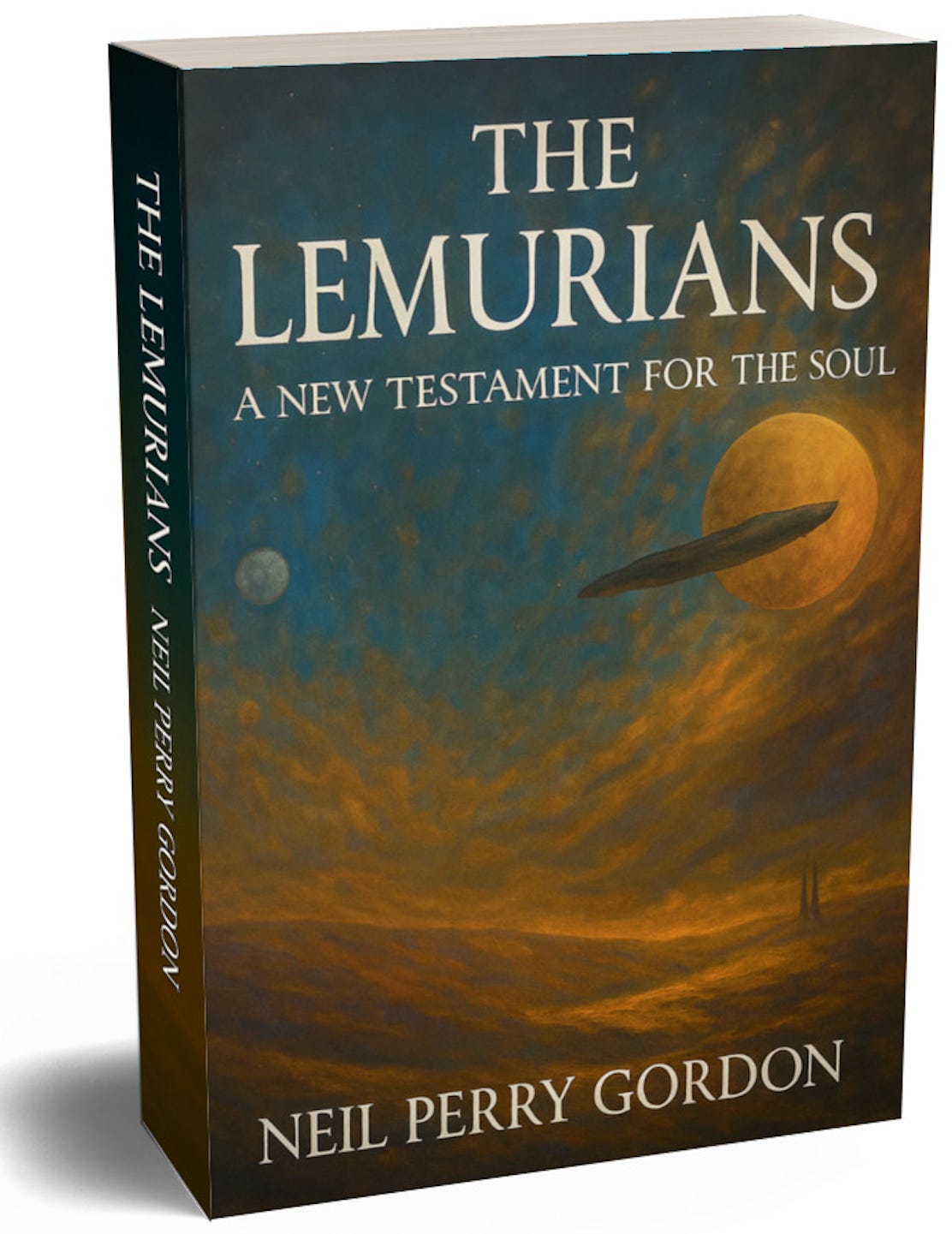
With thirty chapters now released, The Lemurians: A New Testament for the Soul has crossed a quiet threshold. The story no longer feels like something I’m simply writing. It feels like something unfolding—on its own time, with its own rhythm—and I’m finding real joy in witnessing that process rather than controlling it.
What continues to fascinate me most isn’t just the narrative itself, but the space between chapters.
We’re no longer used to waiting in literature. Most novels arrive complete, consumed quickly, absorbed in private, then shelved. This format feels different—closer to the experience of a serialized TV show, when an episode lands and the week that follows is just as important as the hour you watched. Speculation, conversation, re-reading, anticipation. The story doesn’t end when the chapter does. It lingers. It breathes.
And readers are inhabiting that space.
Knowing that people are reading in real time—sitting with unresolved threads, sensing what might be stirring beneath the surface—has changed the energy of the work in a way I didn’t fully anticipate. Not as pressure, but as vitality. Each chapter feels less like a finished object and more like an offering placed into a shared field, where it continues to move and evolve in other minds before the next piece arrives.
That in-between time matters.
It allows imagination to participate. Readers aren’t just following a plot; they’re living alongside it—holding questions, noticing patterns, feeling where something unresolved might be pointing. The story stretches beyond the page into conversation, into memory, into that quiet awareness that something is still forming.
I didn’t expect how communal this would feel.
Writing this way has turned the process into something closer to a dialogue—not about outcomes or theories, but about attention. The story and its readers are moving forward together, chapter by chapter, trusting that what comes next will arrive when it’s ready. Not rushed. Not forced.
There’s a deep joy in that trust.
So if you’re joining now, you’re stepping into a narrative already in motion—one with momentum, memory, and a growing internal coherence.
If you’ve been here since the early chapters, thank you for staying present not just for the releases, but for the pauses.
And if you find yourself lingering between chapters, feeling questions rise rather than resolve—that isn’t a gap.
That is the experience.
This isn’t a story meant to be binged and forgotten.
It’s meant to unfold.
To be talked about.
To be waited for.
And thirty chapters in, it feels unmistakably alive.

https://open.substack.com/pub/stanczakj/p/project-hail-mary-and-the-importance?r=4cnsfa&utm_medium=ios&shareImageVariant=overlay